Showing posts with label Recollection. Show all posts

Thursday, 14 June 2012

Mike Hinge - Remembered by Ron Williams

I have recently received an email from Ron Williams, architect, artist and author of Building and Flying Indoor Model Airplanes. Ron was a friend of Mike Hinge, they were together in the Onyx group and they also both worked for Donald Deskey Associates. I was thrilled to read Ron's valuable memories and I am very pleased to share his message here which I think is a wonderful insight into Mike's persona, life and work. I hope that you find it as fascinating as I have. A very big thank you to you Ron.  
--------------------------------------------------------------------------

Hi Ivan -
I Googled Mike Hinge last weekend and discovered your blog. It's terrific. I'm the Ron Williams referred to in the material about Mike and his involvement with the "ONYX" group. I can tell a bit about Mike and my friendship with him during the late 70s and early 80s. It was pretty intense as I'm sure anyone's encounter of Mike would be.
If I remember correctly, we met while we both worked for Donald Deskey Associates, the design firm. My background was in architecture and his, you know. ONYX was the getting together of Woody (J. Woodson) Rainey, Tommy Simpson, Mike and myself. There were many descriptions of what ONYX meant but largely it was an attempt to bring different sensibilities together and to resist the temptation to declare a manifesto. We published broadsheet/posters that we distributed to friends and colleagues and plastered on the walls of Manhattan's back streets. The name came from the definition of onyx as a many layered stone.
Woody Rainey has taught and practiced architecture in Manhattan since the late sixties. Tommy Simpson has made his way as an artist since I can remember, showing and selling his work all over the North East. Mike exhibited with us showing his art work and published a poster, the Parsec City. Tommy came into contact with us but I can’t remember if he did any specific work that he considered an ONYX project.
Woody did a mandala like calendar for an eight day week and other sheets displaying abstract architectural ideas. My work illustrated architectural projects involving fantasy designs exploring extreme spaces.
When I first met Mike he was living in a 1950s apartment building on West 16th Street just off 5th Avenue. He had a large studio apartment crammed with his work and ongoing projects. He was just beginning to explore electronic light sculptures and designing his type faces. The apartment was piled at least waist high with boxes and portfolios and with narrow passages between the collection to get to the facilities, the kitchen and Mike’s work area.
At the time one of Mike’s main preoccupations was with the state of his collected works and collections stored in Los Angeles. He had trunks and boxes stored in a warehouse there and was defaulting on his rent, in danger of losing it all. I’m not sure what happened to it but the experience would be repeated again and again. I would lose contact with him now and then and in the interim his life would seem to go through many changes though he kept up his work.
He moved to a loft on West 26th Street in Manhattan’s Flower district. The loft was high ceilinged and perhaps 30 by 80 feet. In a matter of months he had filled it with the voluminous material he managed to collect. He was a nightly dumpster diver and found a dumpster near a liquor store that threw out their empty liquor boxes nightly. He tried many different “brands” of boxes before he decided that J&B scotch whiskey boxes best served his needs. He labeled and stacked them, filled with material he figured would be useful or that he couldn’t resist collecting.
He collected giant glass jars that had held pickles and even larger brown plastic olive jars from delicatessens and restaurants. These too were carefully labeled to describe their contents - the variety of those contents was mind boggling.
Often, when wandering around Manhattan with him I would discover that I was “talking to no one” as Mike would disappear when he would see a promising piece of paper on the sidewalk or in the gutter and scoot away to retrieve it. He had receipts, ticket stubs, cigar bands, cigarette packages, every kind of small paper souvenir of someone’s encounter with the city. The J&B boxes were filled with beer cans, brands I’d wonder how he’d found in New York, from all over the world. His glass jars were filled with match books. Unless he had an appointment with someone and a schedule to meet it could take forever for him to get from one place to another. He could not resist stopping into random bars and restaurants to ask for a card and a book of matches. I never saw him drink but he sure had a lot of beers (an unopened full can was prized above all).
The last time I saw his loft, he had the same environment he had on 16th street but times 4 or 5. The stacks of green J&B boxes reached nearly to the ceiling and the aisles between the collections made the place seem more a library or very special warehouse than a home or studio.
We would wander into an out of each other’s lives periodically. I would bump into him and hear that he had lost his last place and that he was living in the studio of someone he was working for. Then he’d have a new place.
I drove Mike down to Reading, Pa once to visit a bunch of his comic/SF pals. He introduced me to Steranko; his followers had discovered the low rent residential area that beat out anything for hundreds of miles. Mike was always on the verge of poverty, living a life of feast or famine during the years we hung out. I think Pennsylvania became a back up for him as a cheap place to live after he saw how the Steranko crew had adapted.
During the late 70s or early 80s I introduced him to a bunch of artist friends that lived in the Tribeca area. They were pioneer lofties moving into and working in the area’s many loft spaces as SoHo became too gentrified. At a party at one of the lofts on a Halloween, if I remember correctly, he showed up with the night’s most outstanding woman and proceeded to give the entire assembly a lesson in dancing. The question of the night: “Who was that guy?”
Mike was quite secretive in many ways. I was surprised to learn of his age on this blog because that was a taboo subject when my friends and I knew him. New Zealand was as much as he would say about his past and nothing about the place at that. When he agonized over the loss of his collections in L. A. he would reveal as little as possible. Knowing how reluctant he was about his history, we would not press him but would tease him occasionally about his unknown age.
Mike rolled his own cigarettes. When someone mentioned that there were those that could roll two at a time he immediately gave an outstanding demonstration of the art.
His taste in music was universal except for one thing about which he was vehement: he could not stand voice. To him to sing was all but sinful and he would not hesitate to express his displeasure with the singer’s art. Opera was the last straw.
My friendship with Mike went dormant during the mid 80s as we both found new pursuits with which to engage. I had written and illustrated a book that was inspired by a short trip we took in 1976 when we visited an international model airplane meet at Lakehurst, New Jersey. Like many of the encounters and friendships one makes in Manhattan, we went our separate ways. The friends we had in common had all moved out of the city. I discovered that he’d died a few months after his passing and could not find much about him on the web. I often wondered what happened to the things he collected – they were attractive to him not as individual objects but as they represented areas of work, design and as a cumulative expression of life. If I had the money at the times his collections were threatened, and the sense to know how important they might be, I would have done more to help him keep them going. Too soon old, too late smart.
Your dedication to his memory is marvelous and he really deserves it. He was a truly unique human being and my life has been made all the richer for having known him.

Friday, 16 December 2011

Mike Hinge - a christmas card

It's nearly Christmas! Thanks very much to Alex Jay for sharing his 1981 Christmas card from Mike


Alex wrote "Mike's 1981 holiday greeting card measures 14 x 17 inches / 35.56 x 43.18 centimeters". 
and "Photocopy colored with markers. The card was scanned in four sections and stitched
together; the alignment is a bit off. Back in Christmas 1980, I visited my parents who lived
in Arizona; we spent a few days in San Francisco with my father's sister. That's what Mike
was referring to in his note".

Thursday, 15 December 2011

Mike Hinge - Nigel Rowe and Mike Kowalski


I was recently put in touch with Nigel Rowe who is a writer, researcher and SF fan. Nigel has written several fanzines and a book Timeless Sands - A History of Science Fiction in New Zealand and contributed to Tom Cardy's obituary for Mike. Nigel told me that he first met Mike in the early 80's and here I am publishing his email to me which include some wonderful memories of Mike. As well Nigel included this rather nifty "Lawrence of Arabia" passport photo of Mike and a very special short story  "The Quest For Mike Hinge's Boxes" by Mike Kowalski drummer of The Beach Boys on a 25th anniversary tour in New Zealand in 1984.

I really hope that we can hear those tapes one day and view some of Mike's early art. Many Thanks to you Nigel.

Mike's passport photo circa 1978.
Mike was a friend of mine who I met in New Zealand in the early 80's. He was amazed when after introducing himself as "Mike Hinge" I replied "Oh, not *the* Mike Hinge who immigrated to the States in 1958..." As a researcher and SF fan for some time I was probably one of the few people in NZ who knew who he was and his subsequent success overseas.

Over the years we kept in touch after he moved back to the East Coast. And when he unexpectedly passed away, I volunteered to take his ashes back to NZ on my next trip. And I delivered these to his brother in the rural wilds of NZ in 2004.

I subsequently bought some of his artwork from his collection as it was sold on eBay. I also own some of his original artwork from the 50's that he gifted to me when we spent a long time sorting through his original NZ possessions that had been in storage down there for the 30 odd years he had been away. I'm including here a story written about the trip to reclaim his stuff from his elderly aunt.

I also owned a bookshop for many years, and Mike helped me get it going.
Including designing the store logo, signs, and selling books when I went off to get lunch. We spent a lot of fun times together before he headed back to the States. I have several hours of him on tape talking about his early days, the Time covers and other interesting stuff that was intended for a magazine interview that never eventuated.

My one regret is that as I too moved overseas (Chicago) I had to part with some cherished possessions including the hand made wooden art drafting table he built in the 50's and left with me. Unfortunately it had too much wood borer after being in storage in humid conditions. Oh well, I enjoyed it while I could.
And it was fun seeing him draw my store logo on it, much the same as when he last used it 25 years earlier.

Enjoy the enclosed. I can't wait to check out your site! He would have been chuffed that 8 years after he shuffled off this mortal coil that people were still enthused and talking about him.

Nigel


THE
QUEST
FOR
MIKE HINGE'S
BOXES
August 1984

Mike Kowalski

We drove down through the rain and hills to Huia.
"This is just like Wellington," said Nigel as we descended. Easy to imagine the bush-clad hills covered instead with houses and winding streets, and aircraft passing through the huge gulf of air between the headlands. The windscreen on the hired station-wagon kept misting up, and it was hard to see through the heavy rain.

The blue Skoda we were following pulled over to the side. Across the road was a row of houses. We clambered out of the car, and I unfolded my umbrella.

The tide was out and the mudflats stretched out past the headlands, which were like a row of great grey spikes fading in the rain.

Mike Hinge, itinerant SF artist, hopped out of the other car and ran to the gate. The driveway was two strips of concrete but ran only from the other side of the gate. Before the gate was a stretch of spongy grass slowly puddling up with water. Mike swung the gates open, and I backed the wagon across the grass, leaving deep muddy ruts, and down the long driveway. The shed doors opened after a fair bit of pushing, and the wagon backed up half inside the garage. Mike went into the house and talked to his aunt and then came back out and showed us to the rear of the shed. The boxes were stacked to one side. They were each a metre and a half long and more than a metre high. The bases of some were damp and rotted; most had been riddled by silver-fish around the metal bands on the ends. These boxes had been sealed for twenty-five years.

We dragged them out one by one and prised them open with a crowbar and a hammer. Dust soon gathered in the rear of the shed, already festooned with cobwebs. Outside the grimy window sat a water-tank grown around with weeds. Mike com plained steadily and bitterly about relatives with no appreciation for the value of culture, as we unearthed time and again some especial treasure damaged by time and age.

The bottom-most crate was full of art material, and this had almost all perished, the most crushing blow to Mike. But three or four boxes of jazz 78's had weathered well, and a few boxes of books. Here were first editions of Arthur Clarke and others, an early Arkham Lovecraft collection, a first British edition of Foundation amidst a whole bundle of books about the saucer craze which had once occupied Auckland fandom. It was hard to guess what, if any, was valuable, but there was a lot that was very interesting. A booklet put out by the ARA (Auckland Regional Authority) in 1955 mapped out proposed changes to the public transport system, most of which still haven't got off the ground.

Finally the wagon was loaded, and the last box went into the other car, after the back seats had been taken out. The ground between the driveway and the road was very soggy by now, and the wagon heavily laden. It didn't seem likely we would be able to get out. So we carried down old planks from the box lids and placed them on the grass. Nigel drove the wagon down the drive and across the grass, managing to miss every single plank. For a moment one of the wheels slid, but he made it to the road. By this time we were all very wet, very tired.

We unloaded the boxes on Queen Street and took them up the lift to Martian Way Press. Mike shouted us dinner at the Hungry Horse. Over coffee we argued politics. It was the day of the General Election (I didn't vote, of course). Back at Nigel's office we phoned the Values Party party at Cathryn Symons' house to find the election result, and to learn that Cathryn - who had stood for election - was not destined to become New Zealand's first fannish politician.

Tuesday, 9 August 2011

Mike Hinge 80th Anniversary: Matt Howarth

Matt is a writer/artist and met Mike Hinge in the early 70's and has written a personal Memoir for Mike remembering his taste in music and particular aspects of his working practice as well writing a short SF story "Domino Afternoons" inspired by the sad experience of clearing Mike's apartment after his passing and a link to a SF novel "Separation Anxiety" in which many scenes he wrote were inspired by Mike's art.

See Matt's work here:


http://www.matthowarth.com/


Unlocking some Hinged Memories
by Matt Howarth 7/2011

            I was a kid the first time I met Mike Hinge. It was at a Philcon (the Philadelphia Science Fiction Convention) in the early 70s; I was a fanboy and he had a table in the Art Show where he was displaying his art and selling his posters. I was familiar with Mike's art (from SF magazines and book covers) and wanted to show him my own (admittedly primitive at the time) art. He proceeded to (verbally) tear my work to shreds, heaping garrulous criticism on my formative art, probably in an attempt to get this fanboy to move along. Unknown to him, though, I was not insulted by his critique; I took his comments to heart and went off to apply his remarks to bettering my art. Much of my sense of design originates from his advice, and I consider him one of my mentors (although he would later rigorously deny that honor, not remembering our first encounter at all).
            The next time our paths crossed, years later at some other SF convention, it was our common tastes in eccentric music that brought us together and cemented a solid kinship that would last to (and beyond) Mike's untimely passing.
            While Mike's tastes were widespread (running the gamut from electronica to reggae to pop to swing bands), my interests tended to focus on electronic music, with strong concentration on the European scene in the 70s. Consequently, he would often pick my brain regarding what was happening in that scene. Mike was a data junkie, and would jot down a lot of my comments on file cards during our discussions for later reference use. Back and forth over the years, we turned each other on to a variety of bands.
            At some point (circa early 80s) Mike was staying at Neal Adams' Continuity Studios in NYC, where he had a niche for his drafting table and boxes of stuff and a ratty mattress shoved in a corner. I remember visiting him there one evening and we spent hours swapping sonic tales. While I had a strong interest in his art (his strong command of stylization shows heavily in my own mature art), the gist of our conversations usually concentrated on music. He would get very excited when I'd tell him about…say, the latest album by Ultravox, for his finances were never opulent, forcing him to appreciate a lot of stuff secondhand. In turn, he would dazzle me with discoveries he'd made scouring the discount bins of Manhattan record shops. That night at Continuity Studios, he pulled out one record and turned me on to Canadian rocker Nash the Slash (with whom I would, years later, form a deep and lasting friendship, working with Nash on several projects…but that's another memoir).
            Over the years Mike and I fell in and out of touch, but inevitably the Great Magnet would bring us back together. I spent a lot of the 80s hanging out in NYC, seeing a variety of concerts--and ran into Mike at many of these gigs. We would catch up on each other's doings, but invariably the topic of our discussions would devolve to music…and endure for hours.
            Years later, when Mike moved into Philadelphia, he would call every once in a while, to check in and chat…but what he really wanted was to be updated on whatever new music I had discovered. "This is silly," I would tell him. "Why are we wasting time talking about music when you could come over and visit--and actually hear some of this stuff?" But Mike was a recluse and would always beg off visiting for some dubious reason, leaving our exchanges limited to discussions about music. On a few occasions I recorded certain albums for him and sent him the tapes--this thrilled him. He was especially grateful for a live Can album I gave him one time; he really loved Can.
            Other bands that Mike enjoyed included: Magazine, Klaus Schulze, the Human League, Japan, Neu, Fad Gadget, OMD, XTC, Ornette Coleman, Led Zeppelin…oh, the list could go on and on. He had a REALLY big collection of music. He also had a lot of 60s Californian psychedelic rock (like Moby Grape). His tastes seemed to focus on experimentation; he was attracted to musicians who pushed the envelope and broke the rules to discover new sonic ground.
            It was only after his passing that I actually got the opportunity to see that collection, when I helped his friend Sandford Meschkow to empty out Mike's cramped apartment. As a diehard audiophile, I refused to allow that collection to end up in the hands of the Salvation Army or in a dumpster. I felt it only proper that his collection be disseminated among his friends who shared his tastes. It took a long time--it was a vast mass--but I feel I succeeded in doing the right thing. (I ended up keeping very little of his records for myself, only because I already had most of the stuff I would've wanted.)
During those post-mortem days, I also assisted in the gathering and organization of Mike's artwork (which was stored in the hands of a variety of his friends) to be handed over to an art agent for sale. At this time I got the chance to view his artist career in its entirety (for Mike was a packrat and never threw anything away). His range was incredible. While he is remembered mostly for his highly stylized SF art, he was an accomplished commercial artist possessing the adept skill of adapting his work to whatever style required by the job at hand. He designed several type faces, and built a few constructions that can only be described as futuristic machines with no more function than to be bewitching to the eye. He'd done numerous paintings, much to my surprise, since I was mainly familiar with his linear work. He worked big, often covering a wall with a sheet of paper on which he would do rough designs which would later be converted to smaller canvases. He kept a vast reference library, consisting of not just books but clipped pictures from magazines, all sorted by topic and stored in folders in plastic bags (to protect them from entropy). He had a sincere fascination for colorful lifeforms, like tropical fish (probably stemming from his youth in New Zealand).
At that point I found myself with a newborn respect for his talent…and a sadness that I would never get the chance to tell him about it. But then, I suspect Mike would've just waved a hand and dismissed my praise, muttering something about doing what was necessary to make it as an artist in the modern world…then he would pull a wad of index cards from his pocket and start interrogating me about what new music I'd found.


--------------------------------------------------------------------------------------------------

            Aside 1: As a workaholic, I'm constantly producing stories (graphic and prose). While the majority of my work is science fiction, sometimes inspiration comes from real life. My short prose story "Domino Afternoons" is one such, stemming from the experience of helping to clear out Mike Hinge's crowded apartment after his demise. 
(Read Matt's story here: http://onyxcube.weebly.com/)

            Aside 2: Being exposed to Mike Hinge's art en masse during posthumous sorting provided me with another such wealth of inspiration. There was a plethora of tantalizing imagery, for Mike's mind was a fertile one. I ended up writing an entire SF novel ("Separation Anxiety") in which many scenes were inspired by Mike's art. As one might expect, robots play a key role in the tale. Interested parties can check out the novel at: www.bugtownmall.com/New_Matt_Howarth_Stuff.htm

Mike Hinge 80th Anniversary : Sanford Zane Meschkow

Sandford is a writer and editor and met Mike Hinge in the mid 60's and has written a personal memoir for Mike remembering certain art projects and the materials and practices he used as well writing a short SF story "A Friend of Max". As well a clarification of Mikes actual date of birth.

See some of Sandford's early SF writing here:


http://www.isfdb.org/cgi-bin/ch.cgi?14512


MICHAEL B. (for BARRY) HINGE: A MIND NEVER AT REST
By Sanford Zane Meschkow


When I first joined science fiction fandom back in the 1960s, authors always seemed to be writing essays in fan publications about being cornered by fans asking them where they got their ideas. Knowing Mike for 36 years, I soon learned where he got his ideas: EVERYWHERE! The artistic potential of all sorts of objects seemed to fascinate him.
When several Philadelphia friends and SF fans helped me clean out his apartment after his death, his effects included a slide projector and a huge collection of slides. A few were of his artwork, most of them sold or lost items. Many more were of views of his kinetic sculptures and frames from incomprehensible experimental movies. But the majority of the slides were part of a huge reference file. Think street signs, fire hydrants, traffic lights, street lamps, sewer grates, manhole covers, store fronts, posters on fences, cast iron gates, etc. It was as if he was collecting reference material to build himself a gigantic back lot version of New York. You might say that this was just the act of a compulsive person. But what did it lead to?
Founded in 1923, Barney’s once was a landmark New York men’s store that filled the whole block at 7th Avenue and 17th Street. Here’s a short paragraph from one of Mike’s resumes: “For Barney’s Clothiers: Supergraphic street mural, concepts for building entrance, lights, graphics, colors, etc. (3-D lettering sign made up of plumbing fittings and pipe, spacing and positioning logo cutout from steel, backlighted in fluorescent tubes).”
That street mural? It was an eye-catching arrangement of representations of manhole covers in a contrasting color on a black background. There were easily a dozen different manhole cover designs represented. Who but Mike Hinge could have conceived of making art out of manhole covers? Yes, if you wanted an illustration of a New York street scene, Mike was the guy to see. No, he didn’t only paint robots on roller skates.
Mike was fascinated by found objects. He collected everything from cigarette packs to, well, money. The U.S. coins he spent, of course, but it astounded us how many coins from Canada, France, and Caribbean and South American countries he had picked up from the street over the years. He had also accumulated a vast collection of bits and stuff for a planned giant collage which, sadly, had to be discarded after he died.
What media did Mike work in? Illustrators and designers used to do rough comps with marker pens. We found a huge set of Berol® PRISMACOLOR ® professional-quality markers that must have included over 100 colors, plus many shades of grey. He had replaced the markers in the original set with newer certified non-toxic markers as he used the old ones up. We would have liked to have donated it, except the oldest markers were so old that the pigments were in solution in some smelly hydrocarbon (benzene? toluene?) that we feared were probably pretty toxic. Working with them in a small room might have made Mike dizzy, but what he would have like about them was their ease of use and their vivid colors. He also liked to use Pelican Plaka casein emulsion paints from Germany and Dr. Ph. Martin’s dyes and acrylics. Robert and Joseph Switzer, who created fluorescent paints (like DayGlo) in 1934 couldn’t have hoped for an artist more eager to use them than Mike, who probably would have liked to have had DayGlo-colored blood.
Mike lived with my wife and I for about 14 months and in return he offered to paint our house – if he could pick the colors. Think of a staid suburban street with one incandescent painted lady of a house on it! We said no, but gently.
Mike liked to work large; the poster was a natural size for him. Also, his big preliminary sketches were as tight and as near completion as some other artist’s final versions. One of his works lost in various moves was a room-sized mural with a historical New Zealand theme that included a lot of Maori art motifs.
Yes, let’s talk of lost art and lost opportunities. Mike told us once that he had decided not to marry because he could never be sure of being able to support a family. He never seemed to have considered the possibility of finding and marrying a woman who worked outside of the home and who might have been capable of providing some cash as well as company during those lean times when art jobs are far apart. Marriage to a creative person can be a rocky road and the Mike I knew would have made a difficult husband, but marriage to the Mike I never knew, the one married to a women who made him happy and could have steered him in the right direction when he needed it – well, that would have been another story. How many covers for ANALOG and TIME might he have done then?
Had Mike been a more famous artist, less of his work would have been lost in moves or dumped when he couldn’t pay storage bills. To pay his taxes and convert some of his belongings to cash for his brother, we filled a van with his paintings and some of his commercial work and sent them off to be auctioned. We were told what not to include. Not his kinetic sculpture, no Parsec City posters, rough sketches, doodles, stats or machine copies of works, nothing of the type of thing that would have had auction value if Mike had been as famous at his death as, say, Jack Kirby. Local friends and fans and I saved some of that unwanted stuff from going into the recycle bin. A lot of that appears on this blog thanks to Ivan. And there is still more out there, so don’t give up, Friends of Mike (FOMs) and inhabitants of Parsec City. Maybe today someone will open a dusty box in an attic that their uncle was holding for some guy named Mike and find it is full of fluorescent wonders.


-----------------------------------------------------------------------------------------------


Aside 1: Copy of an email I received from Sandy Meschkow and a Mike Hinge inspired story:
A Friend of Max.

Dear Ivan,


   I thought the fans of your site might enjoy another bit of fan fiction inspired by Mike Hinge. Mike was no mad scientist, although his electronic sculptures were really something! And he could have made more money during his later years if he were socially adept enough to work with art galleries and smooze more. But he was pretty much a loner and both essentially shy and uncompromising – a bad combination in a field where self-promotion is essential. Mike’s actual apartment is well-described in this story and Mike did have a few friends that kept him going in his later years when the number of science fiction magazines dwindled and the rise of computer graphics cut the ground out from under many established illustrators working in the commercial art field. And if Mike had invented a time machine, it surely would have turned out to have something wrong with it, because he seemed plagued by bad luck.
                                                                                                                                                Sandy Meschkow

Read Sandy's story here: http://onyxcube.weebly.com/


Aside 2: A contribution by Sandy Meschkow regarding Mike's actual birth date.

Mike’s date of birth actually was August 9, 1931. The exact date of his death is uncertain, but it was probably only a few days or two from his birthday in 2003. I still have a big file of letters and stuff about Mike, so it will be no problem to come up with something interesting to say.

Here’s one thing; some sources may say that Mike was born in 1937, and here’s why. When Mike went through the U.S. immigration process, he presented adequate paperwork to establish his date of birth, but in the English (or Continental?) fashion the “1”  at the end of his year of birth had a slash through it, so the clerk read it as a “7”. Mike never bothered to go through the hassle of changing it when he was young. But in his last few years he could have really used those extra years of Social Security that he had been cheated out of by a clerical error. We were furious with him when we found out that he had not taken care of that!! Here was a guy who was known as Captain Copyright for enlightening other artists about their rights and got into hot water with some sleazy publishers by not allowing them to swipe his rights and artwork, but was so intimidated by the U.S. Immigration Service and Social Security Administration that he didn’t dare try to get his date of birth corrected. It’s really sad! We helped him sign up for Social Security and you could tell he was sweating bullets through the whole process. 
                                                                                                                                             Sandy Meschkow   


Mike Hinge 80th Anniversary: Alex Jay

Below is an edited version of e-mails exchanged between Alex Jay and myself. Alex is an artist and was a friend and colleague of Mike Hinge and kindly shared with me some interesting facts and images which shed some light into the breadth of Mike's creative work.

http://comicbookdb.com/creator.php?ID=6724
-----------------------------------------------------------------------------------------------------------

From: Alex Jay
Sent: 27 July 2011 13:53
To: Ivan Richards
Subject: Mike Hinge Blog

Hello Ivan, 

Sandy Meschkow told me about your blog and sent your email address to me.

I've known Mike since 1978 when I met him at Neal Adams' studio, Continuity Associates, in 
New York City; Mike rented a room there. I was invited to rent a space in 1980. My background 
was graphic design so we had a lot in common. I also did a fair number of comic book logos 
which can be seen at the Comic Book Database, comicbookdb.com/creator.php?ID=6724; click 
on the link for Machine Man and you'll see where Mike's Monkey Wrench typeface came from. 
I'll say more about it in another email.

Thank you for creating a blog about Mike and his designs. Most of it I've never seen because 
he had it in storage. Regarding your post #119, I can show you Mike's designs from the 13th 
Annual Type Director's Club Show (TDC XIII) of 1967; they were part of the ad campaign for 
Mexico Magnifico.  (click on images to enlarge)


Annual TDC XIII                                          Mike Hinge's winning ad for Mexico Magnifico


On Thu, Jul 28, 2011 at 7:15 AM, Ivan Richards  wrote:
Hi Alex
Thank you so much. This is fantastic information. It is really cool that you have the 13th Annual Type Director's Club Show catalogue and have scanned the pages, I would love to put the scans for blog. What a surprise, The Mexico Magnifico is familiar to me as I have two tags and a flyer with the design, I wonder if Mike got a wage raise for getting a prize?
(...)


All the very best
Ivan

------

From: Alex Jay
Sent: 28 July 2011 19:48
To: Ivan Richards
Subject: Re: Mike Hinge Blog

Hello Ivan, 

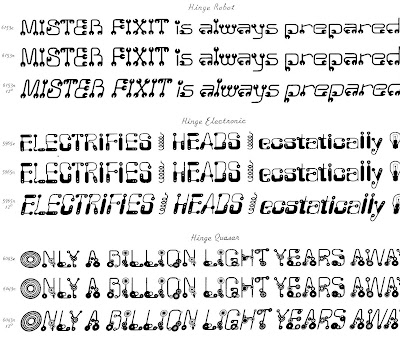
Here are the samples of Mike's typefaces from the Alphabet Thesaurus Vol. 3, A Treasury of Letter Design by Photo-Lettering Inc., 1971.

The typefaces were identified by name and number; the number was followed by a letter.
n = normal
c = compressed (stretched north and south)
e = expanded (stretched east and west)

Most were shown in italic at a 12 degree forward slant; a few had an outline sample.


Do you have the book, The Mars One Crew Manual? It was published here by Ballantine 
Books in 1985. I designed it and hired Mike to do some technical drawings; the art credits 
are on the copyright page. He also designed the patch on the cover; the art was by 
another artist. If you can't find it, I might have an extra copy in my basement.

Onyx was represented in the periodical Design Quarterly. It's also in the basement.

Did Mike get a wage increase for his work in TDC XIII? I doubt it because his firm paid the 
entry fee, and the hanging fee for the exhibition. Most likely he got a pat on the back, a 
hearty congratulations and a copy of the award certificate.

Best,
Alex


On Mon, Aug 1, 2011 at 9:26 AM, Ivan Richards  wrote:
Hi Alex
Thank you so much, a dream come true. It's really good to have the Plinc vol. 3 scans I will put them on Onyxcube blog for Mike's birthday. I had always wondered which book Mike's typefaces would be in. This book is worth a small fortune, along with your Director's Club Show catalogue. My favourites are Hinge Electronic and Hinge Quasar. The Quasar looks familiar I think that I might have an illustration in a book somewhere with this design.
I'd love to see the periodical Design Quarterly with the Onyx font. Do you know of any other fonts Mike designed? Some while ago I remember seeing a font rough design on ebay and didn't make a note or copy of it, which i always do now.
Yes I am lucky to already own a copy of The Mars One Crew Manual. It's very good and great design lovely and complex. There are masses of illustrations here, I wonder how long it might have taken to do? How long would it have taken for Mike to complete one of the large technical pictures? Would he have used photoraphs and traced? It is a nice book and hasn't yet been given enough attention on the web, it's on my list to post some images and info sometime soon.
(...)
Many thanks again
All the best
Ivan.

------
From: Alex Jay
Sent: 01 August 2011 20:08

To: Ivan Richards
Subject: Re: Mike Hinge Blog - thank you


Hi Ivan, 

Attached is a scan of the cover of "Design Quarterly 78/79: A Special Double Issue on 'Conceptual Architecture'"; near the top of the cover, the letter is addressed to Onyx and others; near the bottom you'll see "ONYX (pages 42-46).

On page 44 Mike was represented by his Parsec City illustration of the space vehicle flying into the wall of circuits with the title, Parsec City, is in the upper right corner. I'm sure you've seen this illustration. On page 46 all four members of Onyx were represented; Mike's design is in the top right. This issue of DQ was perfect bound or square back; I did not want to crack the spine to get a better scan of Mike's design. I have no information on the other three members of Onyx, who had some background or interest in architecture. I'm not aware of a font, by Mike, called Onyx.

In the next email, I'll write more about the Mars One Crew Manual and related graphics.

Best,
Alex


From: Ivan Richards
Subject: Re: Mike Hinge Blog - Onyx group
To: Alex Jay
Date: Tuesday, 2 August, 2011, 13:20

Hi Alex,
Thank you very much, this Onyx group is very interesting. It is the first I have heard of it. Initially I thought you meant that Onyx was a typeface as I have a letterhead in my collection that has ONYX in an unusual green font and then a New York address, it's posted in my blog 119. I have made a quick search of the other members of Onyx but I think it will need a finer search to find them all. I wonder what other projects Onyx were involved with and if they had a manifesto, (...)

(...)

All the best

Ivan.

------
From: Alex Jay [mailto:alexjay10@gmail.com] 
Sent: 02 August 2011 03:18
To: Ivan Richards
Subject: Mars One

Hi Ivan, 

As I mentioned in an earlier email, Mike designed the Mars One patch which was rendered by another illustrator. 
Attached are the alternate patch designs plus unused logos. Many of the logos were influenced by other fonts, 
which he incorporated into the name. There were some exciting-looking logos but the editor and marketing head 
at Ballantine Books wanted the cover to have some resemblance to the Space Shuttle book which was by the 
same author. The Ballantine art director made the font selection for the cover.

The author supplied the technical drawings and most were used, as is, in the book. (There is a full-page photo 
of the author, dressed in uniform, in the book. I cut out a press-proof of the patch and taped it to his uniform.) In 
some cases the drawings needed to be modified and there's where Mike came in. I'd explain to Mike what the
 author wanted in the new drawing and then we would go over the reference material and discuss what to do. He 
took the material and returned in a few days or so with the finished illustrations. This was done over a period of 
about four weeks.

I have a few photos of Mike, from November 2002, to share with you in the next email.

Best,
Alex


From: Ivan Richards
Sent: 03 August 2011 13:21
To: Alex Jay
Subject: Re: FW: Mars One

Hi Alex
Thank you very much, I wanted to first re look at my copy of Mars One, before replying. I had a good look again last night and have the copy here with me. It is such a clearly laid out book and with excellent notes crediting the art work. It has some great technical drawing from Mike (and you) with the occasional noticible Hinge style. With all the technical detail it might have been a joy for mike to do, there's a nice illo of a communication station 2.5.1 that has some buttons which he's used in other illustrations which is a nice continuity. The main computer console 6.1.1 looks amazing. Understandably the project didn't call for stylised drawings pity as i think it would be even more stunning. The drawings are they drawn large do the originals still exist?(...)

(...)

I look forward very much to seeing the photos of Mike.

All the very best

Ivan.

------
From: Alex Jay

Date: Thu, Aug 4, 2011 at 1:49 AM
Subject: Re: FW: Mars One
To: Ivan Richards

Hi Ivan,

Photostats were made of Mike's original art. These photostats or line positives were pasted, along with the photo-typesetting of the text, on the mechanical. (These are terms from the pre-didgital age.) The original art was returned to Mike who always made a point of getting his art returned. I assume Mike stored the Mars One art with his other art. On this project I believe he did a few alternate drawings.

Back in November 2002, I invited Mike to spend the Thanksgiving weekend with my family, in-laws and my wife's relatives. I hadn't seen him for a few years so it was good to see him again. Actually, the last time I saw him was at my wedding back  in 1994. The next day we travelled around the city; he always loved New York City and missed it very much. There are three photos of him at the World Financial Center which was across the street from what was the World Trade Center, which was now a construction pit. This was 14 months after the September 11 attack. In the photo of the palm trees, Mike is standing in front of the second row from the left. Debris from the Trade Center towers crashed through the atrium and badly damaged the area where Mike and the trees are standing. This area was rebuilt in about a year. The other two photos of Mike shows him standing in front of the large glass windows. At the time, this location offered the best view of the World Trade Center construction pit. The tall slender building next to Mike is a hotel which is on the east of the Trade Center. If I recall correctly, we went to the East Village and had lunch at an Indian restaurant, one of Mike's favorite cuisines.

The other group of photos were shot at the 42nd Street subway station at Times Square. Mike is standing under pop artist Roy Lichtenstein's mural. You can read more about it here, www.mta.info/mta/aft/permanentart/permart.html?agency=nyct&line=A&station=5&artist=1
(...)  From the subway we walked to the street level and on to the bus station.
At the bus station we said our good-byes and that was the last time I saw him. Later, we talked a few times on the phone; one conversation was about a portrait he was working on of my wife. Then, in August 2003 I got a call from Larry Hama, who got a message from Jim Steranko, who was notified by Sandy Meschkow, about Mike's sudden passing.

Lastly, regarding the ONYX letterhead, I don't know if it was for Mike or the group. Mike told me he lived in the Chelsea neighbourhood which is on the west side of Manhattan. The address on the letterhead is an east side location.

Hope you enjoy the photos.
Best,
Alex